
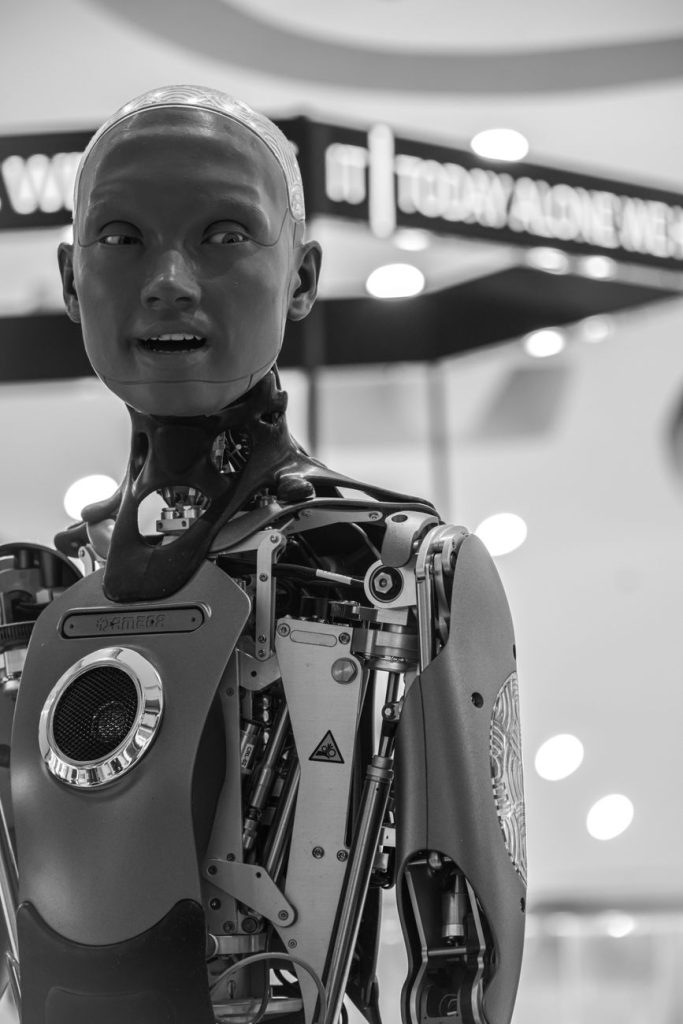
Industrial leaders in Munich and Shanghai this week unveiled a new generation of humanoid and warehouse robots powered by multimodal machine learning systems, marking a decisive shift from single-task automation to context-aware autonomous agents. The announcements, made during the annual Global Robotics and AI Summit and parallel product launches, signal that the convergence of large language models, computer vision, and advanced motor control has reached a commercial inflection point. This wave of technology is arriving now because of steep declines in sensor costs, the maturation of edge-computing hardware, and the release of massive, open-source training datasets that allow robots to learn from human demonstration at scale.
The robotics industry has historically relied on meticulously programmed routines. A traditional assembly arm repeats the same motion millions of times, blind to changes in its environment. Over the past decade, deep learning improved perception, enabling robots to identify objects, but decision-making remained brittle. The current breakthrough involves foundation models trained on internet-scale text, image, and video data. These models provide a form of common-sense reasoning that robots can apply to novel situations.
Companies are now embedding these models directly into robotic control loops. One prominent example is a pick-and-place system that can handle previously unseen objects with 97% accuracy, according to benchmarks released by the Fraunhofer Institute for Manufacturing Engineering. Another is an autonomous mobile robot for hospitals that navigates crowded corridors and operates elevators without infrastructure modifications, relying entirely on onboard multimodal processing.
Experts emphasize the critical role of synthetic data and simulation. Dr. Elena Vasquez, a senior research scientist at the AI Robotics Lab in Zurich, noted that training policies entirely within physics-based simulators and then transferring them to physical hardware has compressed development cycles from years to weeks. She added that modern reinforcement learning frameworks allow robots to practice millions of failure scenarios in virtual environments, eliminating costly physical trials.
Data also reveals a significant acceleration in venture funding. PitchBook data shows that global investment in AI-driven robotics startups reached $8.2 billion in the first half of 2025, surpassing the total for all of 2024. This capital is flowing primarily into warehouse automation, surgical assistance, and agricultural robotics, where labor shortages are acute.
However, the deployment of these systems raises critical questions about workforce transitions and operational risks. Industry analysts point out that while robots can now handle complex manipulation tasks, they still struggle with extreme edge cases and unpredictable human behavior. The International Federation of Robotics reports that collaborative robot installations grew by 18% year-over-year, but safety standards are still being updated to address adaptive, learning-enabled machines.
The implications for the broader economy are profound. Small and medium manufacturers, previously priced out of automation, are beginning to lease robots with cloud-based AI updates, transforming robotics from a capital expenditure into an operational subscribe-and-ride model. This shift could unlock a new wave of productivity in sectors like textiles, food processing, and recycling, which have remained labor-intensive.
Looking ahead, the next frontier involves robots learning from each other through federated cloud networks, where one machine’s experience can be shared across thousands of units without compromising proprietary data. Also watch for the emergence of on-device language models that allow operators to instruct robots using natural language commands, removing the requirement for specialized programming skills entirely. These developments will likely accelerate over the next 18 months as chipmakers release specialized inference accelerators designed for robots that consume less power while delivering exponential performance gains.