
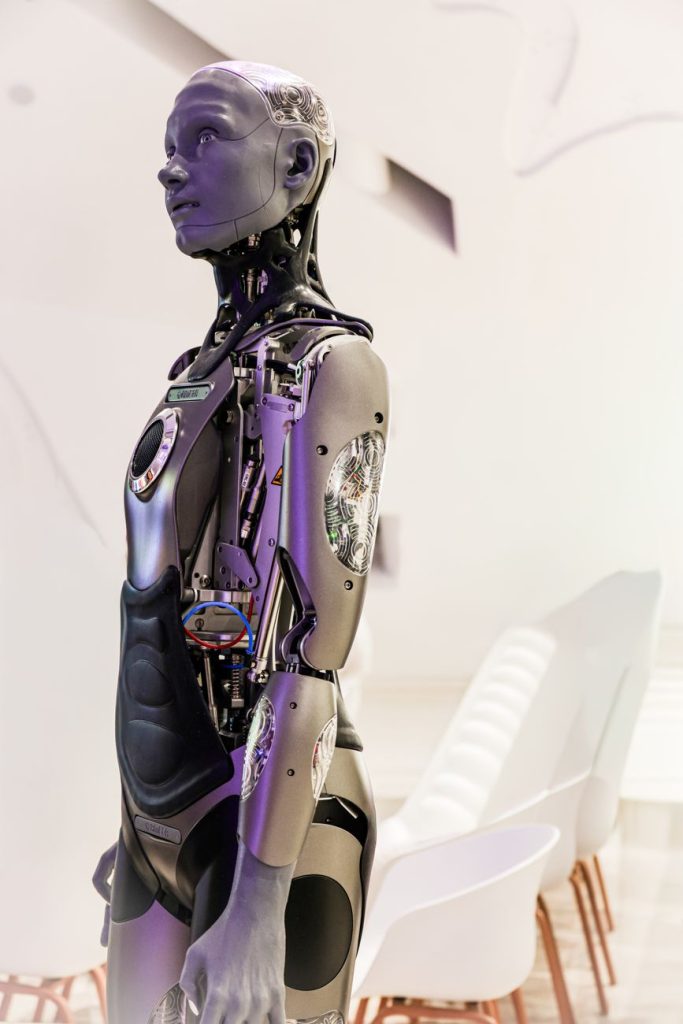
Humanoid robots powered by advanced machine learning are moving from research laboratories into commercial factories and warehouses in 2025, as companies including Figure AI, Tesla, 1X Technologies, and China’s Unitree deploy prototypes for real-world tasks. This shift marks a turning point for embodied AI, driven by persistent labor shortages and breakthroughs in large language models that let robots understand speech and adapt to unfamiliar environments. The deployments are happening now across manufacturing hubs in the United States, Europe, and Asia, and they signal a faster-than-expected convergence of robotics and generative AI.
The Road to Embodied Intelligence
For decades, industrial robots remained inside safety cages, performing repetitive motions programmed line by line. The new generation of humanoid robots breaks that pattern, using neural networks trained on massive datasets to perceive, reason, and manipulate objects in real time.
Large language models have become the cognitive core of many systems. They translate commands like ‘pick up the blue part’ into sequences of motor actions. Vision-language-action models, such as Figure AI’s Helix, combine camera input with language instructions to control a robot’s arms and hands without task-specific code.
Deployments and Announcements
Figure AI said in February 2025 that its Figure 02 robots had begun sorting parts at a BMW plant in Spartanburg, South Carolina. The company describes Helix as the first vision-language-action model capable of handling entire warehouses of unseen objects.
Tesla has shown its Optimus humanoid walking and folding clothes in video demonstrations, with CEO Elon Musk claiming the robot could reach production by 2026. 1X Technologies, backed by OpenAI, is testing its NEO robot in security and logistics roles across Europe.
Chinese firms are moving just as quickly. Unitree’s humanoid robots appeared in choreographed public demonstrations in Shenzhen, and UBTech’s Walker S is working on assembly lines at Foxconn and BYD facilities, according to company statements.
Data, Scale, and the ChatGPT Moment
Developers say the biggest bottleneck is no longer hardware but data. Robots need millions of examples to learn grasping, walking, and reasoning. Many companies use remote teleoperation to collect demonstrations, while simulated environments generate synthetic data for reinforcement learning.
The field is experiencing its own ChatGPT moment, said Chelsea Finn, a Stanford professor and robotics researcher. Once models have enough diverse data, they begin to generalize to new tasks and objects they have never seen.
Goldman Sachs Research projects the humanoid robot market will reach 38 billion dollars by 2035, up from an estimated 3 billion dollars in 2025, though it cautions that technical and cost hurdles remain. A single humanoid still costs between 30,000 and 150,000 dollars, depending on configuration.
Labor Markets and Workforce Impact
Employers are adopting humanoids to fill roles that are physically demanding or hard to staff. The World Economic Forum’s Future of Jobs Report 2025 predicts that automation will displace 92 million jobs globally by 2030, while creating 170 million new ones, for a net gain of 78 million.
Factory workers face the most immediate exposure. Union groups have called for clear retraining programs as companies pilot robots alongside human crews. Industry analysts note that most current deployments are narrow: robots handle one or two tasks, while humans oversee quality control.
Safety, Regulation, and Trust
Safety remains a central concern. Humanoid robots share physical space with people, which requires reliable collision avoidance and fail-safe behaviors. Regulators in the European Union are drafting rules under the AI Act that classify high-risk robotics, while the United States has yet to issue federal guidelines.
Researchers at the IEEE Robotics and Automation Society say testing standards and certification are still immature. We need transparent benchmarks for reliability before these machines work in public-facing settings, said IEEE fellow and robotics engineer Cynthia Breazeal.
What to Watch Next
The next phase will hinge on whether companies can cut costs and prove long-term reliability. Watch for large-scale pilot results from BMW, Foxconn, and other manufacturers, as well as new model releases from OpenAI-backed startups and Chinese robotics firms.
If the current pace holds, humanoid robots could move from novelty to standard equipment in logistics and manufacturing by the end of the decade. The race is not just about building better bodies; it is about who can create the most capable artificial brain to guide them.