
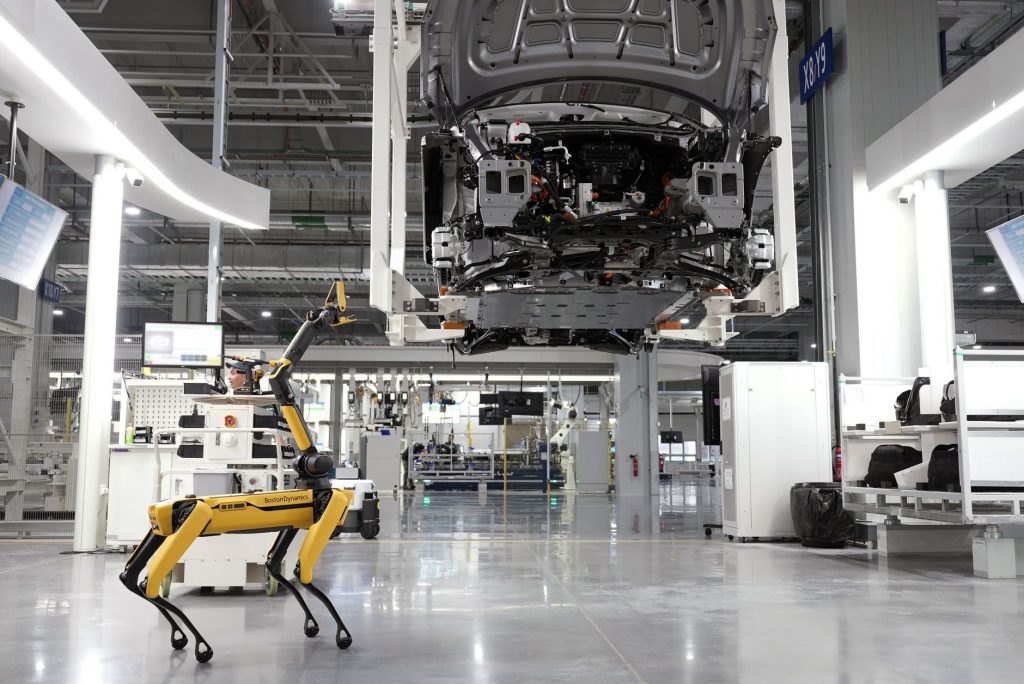
In January 2025, commercial manufacturing plants across North America and Europe began integrating a new generation of humanoid robots powered by advanced multimodal artificial intelligence, marking a critical shift from experimental laboratory testing to real-world industrial deployment.
Leading robotics developers, including Figure AI, Apptronik, and Boston Dynamics, are deploying these autonomous machines to address persistent labor shortages and automate high-precision, repetitive tasks on active assembly lines.
This deployment represents the first large-scale commercial test of “embodied AI” in heavy industry, fundamentally altering how humans and machines interact in shared workspaces.
The Evolution of Embodied AI
For decades, industrial robotics remained confined to rigid safety cages, programmed to execute highly specific, repetitive paths without any understanding of their surrounding environment.
If a part was misaligned by even a few millimeters, traditional factory robots would fail or halt production entirely.
The recent integration of Large Behavior Models (LBMs) and multimodal vision-language-action (VLA) models has transformed these machines into adaptive agents capable of understanding natural language instructions and navigating dynamic, unpredictable workspaces.
This convergence of generative AI and physical hardware allows robots to learn from human demonstration, translate visual inputs into physical actions, and correct their own mistakes in real-time.
According to a comprehensive 2024 analysis by Goldman Sachs, the global market for humanoid robots could reach $38 billion by 2035, driven by rapid advancements in actuator technology, battery efficiency, and AI-driven motion planning.
From Pilot Programs to Factory Floors
Automotive giants are serving as the primary testing ground for these intelligent machines.
BMW Manufacturing recently completed a successful trial phase using Figure 01, a humanoid robot, at its Spartanburg, South Carolina facility, where the robot successfully performed sheet metal manipulation and chassis assembly tasks.
The robot demonstrated the ability to identify, grasp, and place complex metal components with millimeter-level accuracy, operating completely autonomously without human intervention.
Similarly, Mercedes-Benz has partnered with Apptronik to deploy the “Apollo” humanoid robot to deliver parts to production lines and inspect finished components.
These robots operate alongside human workers, utilizing advanced LiDAR, stereoscopic cameras, and real-time computer vision systems to ensure workplace safety while maintaining operational efficiency.
However, the transition to physical AI introduces significant technical hurdles, particularly regarding energy efficiency and mechanical reliability.
While software-based AI models can run continuously in cloud data centers, physical robots are limited by battery life, which currently averages between two to five hours of continuous operation under heavy industrial loads.
Furthermore, the mechanical wear and tear on complex joint actuators requires robust maintenance schedules that many traditional factories are not yet equipped to handle.
Industry Data and Expert Skepticism
“We are witnessing the democratization of physical automation,” says Dr. Elena Rostova, Director of the Robotics Initiative at the Munich Institute of Technology.
“The breakthrough is not just in the hardware, but in the robot’s ability to generalize tasks without requiring thousands of lines of custom code for every new movement.”
Instead, these machines learn by watching video demonstrations and practicing in simulated environments before entering the physical world.
Despite the optimism, some industry analysts urge caution regarding immediate widespread adoption.
A recent survey by the International Federation of Robotics (IFR) revealed that while 70% of manufacturing executives plan to invest in AI-driven robotics by 2026, integration costs and legacy infrastructure remain major barriers to entry.
Retrofitting an older factory to accommodate autonomous mobile robots requires significant capital expenditure and network upgrades, including the deployment of private 5G networks to ensure low-latency communication between robots and central control systems.
Furthermore, labor unions have raised concerns about the long-term impact on employment, urging companies to focus on collaborative “cobot” models that augment human labor rather than replace it entirely.
Industry advocates counter that these robots are currently targeted at dull, dirty, and dangerous tasks that human workers increasingly avoid, such as lifting heavy payloads in hot environments or handling toxic materials.
The Road Ahead for Embodied Intelligence
As deployment scales throughout 2025, the focus of robotics development is shifting from basic mobility to complex manipulation and fine-motor skills.
Researchers are currently training models on massive datasets of physical interactions, aiming to give robots the tactile sensitivity required to handle delicate materials like fabrics, wiring harnesses, and organic products.
This will pave the way for humanoid robots to enter sectors beyond manufacturing, including logistics, agriculture, and eventually, healthcare and elder assistance.
In the coming months, keep a close watch on the development of standardized regulatory frameworks governing safe human-robot collaboration in open workspaces.
Additionally, the establishment of “robotics-as-a-service” (RaaS) subscription models is expected to lower the financial barrier for small and medium-sized enterprises, potentially accelerating the automation of global supply chains faster than previously anticipated.
The race to perfect physical AI is no longer a futuristic concept; it is an active industrial revolution taking place on factory floors today.