
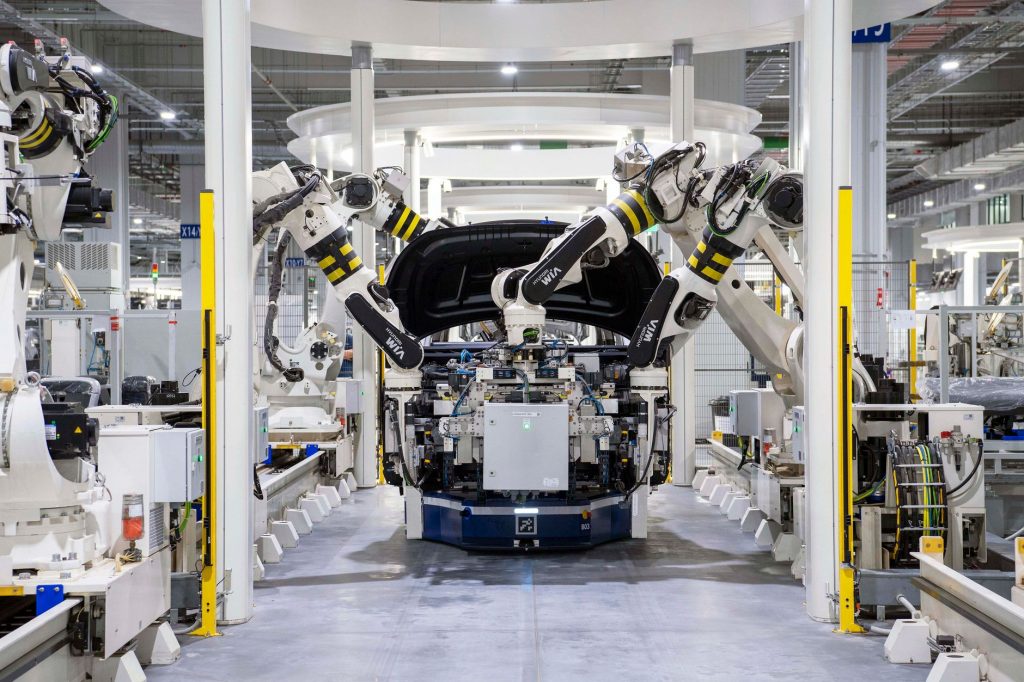
In May 2024, leading robotics developers and artificial intelligence research firms accelerated the deployment of humanoid robots equipped with advanced machine learning models into commercial manufacturing facilities across the United States and Europe, marking a pivotal shift from experimental laboratory testing to real-world industrial labor.
The Shift to Embodied Artificial Intelligence
For decades, industrial automation relied on stationary robotic arms programmed to perform highly repetitive, singular tasks. These machines operated inside safety cages, isolated from human workers due to their inability to adapt to unexpected changes in their environment.
The recent convergence of Generative AI and robotics, often termed “Physical AI” or “Embodied AI,” has dismantled these limitations. By integrating Large Language Models (LLMs) and Vision-Language-Action (VLA) models directly into robotic hardware, developers have created machines that can perceive, reason, and act in dynamic environments.
This technological leap allows robots to understand natural language commands and translate them into physical actions. Instead of writing thousands of lines of code to teach a robot how to pick up a specific box, operators can now simply tell the machine what to do.
Commercial Pilots and Industry Partnerships
Several high-profile partnerships have catalyzed this transition over the past quarter. Figure, an AI robotics startup, recently deployed its Figure 01 humanoid robot at a BMW manufacturing plant in South Carolina, demonstrating the robot’s ability to perform complex sheet metal assembly tasks.
Similarly, Boston Dynamics retired its hydraulic Atlas robot in favor of an all-electric model designed specifically for commercial application. This new iteration utilizes advanced reinforcement learning algorithms to navigate complex industrial layouts alongside human workers.
According to a 2024 report by Goldman Sachs, the global market for humanoid robots is projected to reach $38 billion by 2035, up from previous estimates of $6 billion. The financial institution attributes this massive upward revision to rapid breakthroughs in LLM-driven cognitive abilities and declining hardware component costs.
The Technology Behind the Movement
At the core of this revolution is the development of foundation models designed specifically for physical bodies. These platforms enable robots to learn from a mix of human demonstration, simulated environments, and trial-and-error reinforcement learning.
Vision-Language-Action models represent a major architectural milestone. Unlike traditional AI that processes text or images in isolation, VLAs process multimodal inputs simultaneously. A robot equipped with a VLA model can look at a cluttered workbench, identify a specific tool based on a verbal description, plan the physical path to reach it, and adjust its grip strength based on the object’s perceived material—all within milliseconds.
Through imitation learning, a robot observes a human operator performing a task via video feed or virtual reality. This approach drastically reduces training times. Tasks that previously required months of manual programming can now be mastered by neural networks in a matter of days or even hours.
Expert Perspectives on Safety and Adaptability
Industry experts emphasize that the transition to physical AI is not merely about mechanical dexterity, but cognitive adaptability. Dr. Kenji Suzuki, a leading researcher in human-robot interaction, notes that the true breakthrough is the robot’s ability to handle edge cases—unforeseen obstacles or errors that would typically freeze a traditional automated system.
The economic drivers behind this push are equally clear. Manufacturing sectors in the United States, Europe, and East Asia are facing unprecedented labor shortages. The U.S. Chamber of Commerce reports over 600,000 vacant manufacturing jobs in the country, suggesting humanoid robots offer a scalable solution to fill these gaps, particularly in roles involving hazardous conditions or repetitive strain.
However, safety remains a primary concern for labor unions and regulatory bodies. The International Federation of Robotics (IFR) recently published guidelines advocating for strict hardware-level safety limits, ensuring that even if an AI model suffers a software glitch, the physical robot cannot exert force beyond safe human thresholds.
Future Implications and What to Watch
The integration of machine learning and robotics will likely redefine global supply chains over the next decade. As these systems become more affordable and versatile, manufacturers may begin reshoring production facilities closer to consumer markets, reducing reliance on long-distance logistics.
In the near term, observers should monitor the standardization of robotic operating systems. Much like Android standardized mobile software, a unified foundation model for physical AI could democratize the industry, allowing smaller hardware startups to deploy highly capable robots without developing proprietary AI from scratch.
Additionally, the transition of these technologies from structured factory floors to unstructured environments, such as eldercare facilities and retail spaces, will serve as the ultimate test for the adaptability of modern machine learning algorithms.