
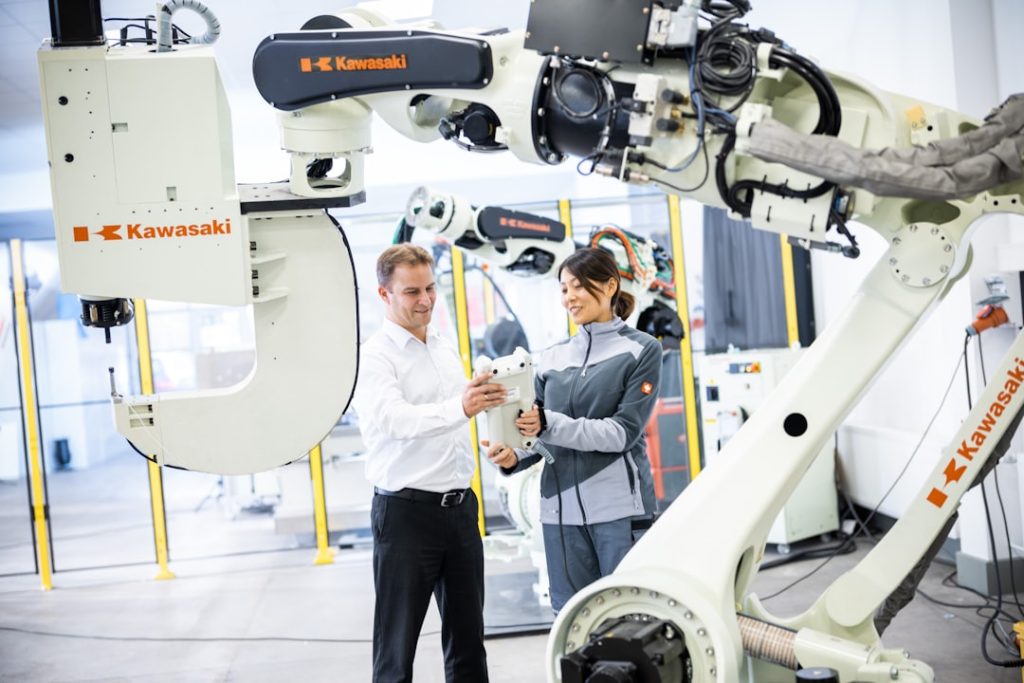
Humanoid robots, powered by breakthroughs in machine learning, are moving from research laboratories into commercial factories and warehouses—assembling vehicles, unloading trucks, and sorting parcels—as major robotics companies and automakers accelerate deployment in the fourth quarter of 2025. This shift marks a pivotal moment for artificial intelligence: after reshaping text, images, and code, AI now learns to control physical bodies.
Context: The Long Road to Embodied AI
For decades, industrial robots have been bolted to factory floors, performing repetitive tasks behind safety cages. Humanoid robots promise something different: they navigate spaces built for people, use the same tools, and collaborate without requiring a factory redesign. The missing piece was software.
Traditional robot programming requires engineers to script every motion. Today, large language models and diffusion policies let robots learn from demonstrations, simulations, and trial-and-error. ‘The core change is that robots no longer need explicit instructions for every joint,’ says Dr. Elena Voss, a roboticist at MIT’s CSAIL. ‘They learn high-level goals from language and convert them into low-level actions.’
Main Body: From Lab to Plant Floor
The deployment pace has quickened dramatically. At BMW’s Spartanburg plant, Figure’s F.02 humanoids handle sheet metal manipulation—a task demanding force controland adaptability. Figure says its robots improve through a ‘robot reasoning model’ trained on millions of real-world trajectories. The company raised $675 million at a $2.6 billion valuation in 2024, with backing from OpenAI, Nvidia, and Microsoft, according to PitchBook.
Tesla’s Optimus, meanwhile, sorts battery cells at its Austin factory. CEO Elon Musk has said he expects production-scale Optimus units by 2026, though external analysts remain skeptical about timelines. In China, UBTech’s Walker S1 has completed trial shiftsat Zeekr’s electric vehicle plant, picking components and handing tools to workers.
Data underscores the acceleration. Goldman Sachs Research projects the humanoid robot market could reach $38 billion by 2035, up from roughly $500 million in 2024. The International Federation of Robotics reports that global industrial robot installations hit a record 541,302 units in 2023, and humanoids, while still a fraction, are growing at the fastest clip.
Expert Perspectives: Capability and Caution
Not everyone believes humanoids are ready for prime time. ‘The current generation is impressive in narrow tasks, but broad generalization remains unsolved,’ says Voss. ‘A robot that can fold laundry may still fail to open a drawer it has never seen.’
James Park, an analyst at ABI Research, sees economics as the driving force. ‘The cost of sensors, actuators, and compute has fallen sharply. As the price of a humanoid drops toward $20,000, the business case against a $60,000 annual worker becomes compelling—especially for dull, dirty, and dangerous jobs.’
Safety and oversight remain open questions. The European Union’s AI Act, now in force, classifies robots operating in public spaces as high-risk, requiring risk assessmentsand human oversight. In the United States, OSHA has begun drafting guidelines for collaborative robots, though no federal framework exists.
Implications: The Hybrid Workforce Takes Shape
For workers, the immediate effect is augmentation, not replacement. BMW says its humanoids handle ergonomically difficult tasks, freeing employees for higher-value work. Over time, however, economic pressure will intensify. The World Economic Forum’s Future of Jobs Report 2025 predicts AI and automation will displace 83 million jobs globally by 2030, but also create 69 million new ones—many in robot supervision, data labeling, and maintenance.
Manufacturers must prepare for a hybrid workforce. That means redesigning workflows around human-robot collaboration, investing in teleoperation infrastructure, and training workers to manage exceptions when robots encounter unfamiliar situations. Policymakers need to update safety standardsand liability rules, especially as robots gain more autonomy.
What to Watch Next
Watch for the next generation of foundation models trained specifically on robotic data. OpenAI, DeepMind, and several startups are racing to build a ‘GPT for robotics’—a single model that can control many different robot bodies. Also watch for the first large-scale ‘million-mile’ robotic dataset, which could unlock true physical intelligence by allowing robots to learn from each other’s experiences.
In the coming months, expect more proof points—or setbacks—as humanoids face the messy, unpredictable reality of real factories. The technology’s trajectory will depend less on flashy demos and more on reliability, cost-per-hour, and trust.