
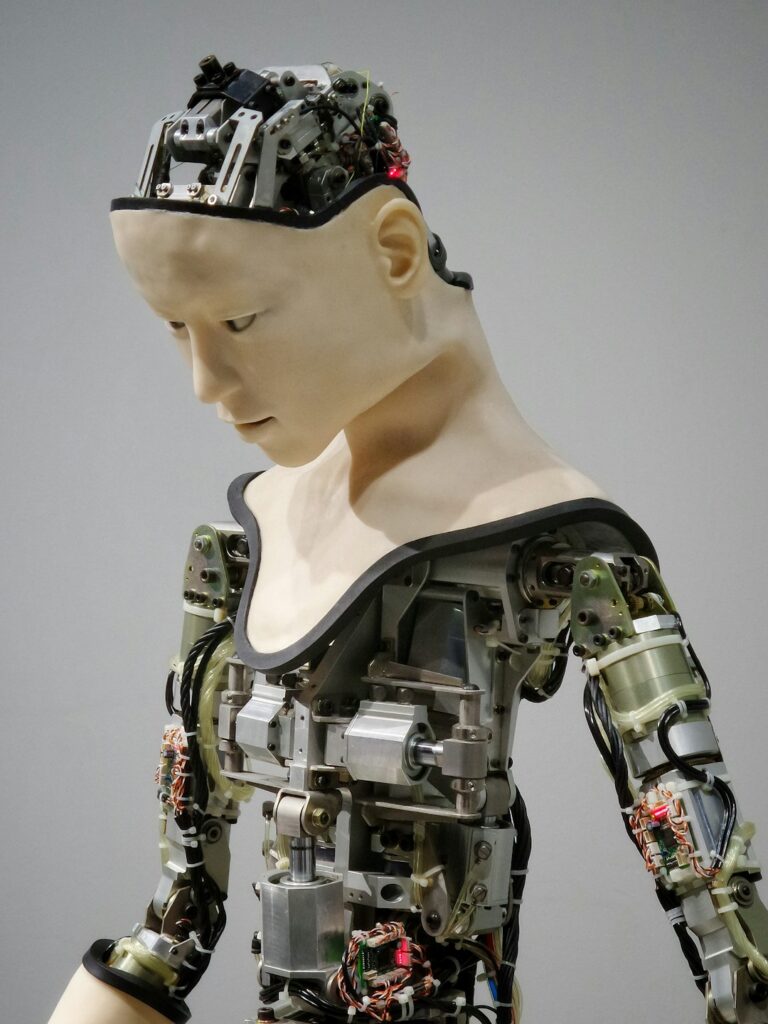
A wave of humanoid robots entered commercial deployment this month as Figure AI, Agility Robotics, and several Chinese manufacturers announced expanded pilot programs at logistics facilities across the United States and Asia, marking the industry’s most significant shift yet from laboratory demonstrations to paid, full-time labor. The announcements, made during the first week of February 2025 at facilities in Texas, Oregon, and Guangdong Province, come as analysts at Morgan Stanley project the global humanoid robot market could reach $5 trillion by 2050. The move signals that general-purpose robots, long a staple of science fiction, are beginning to earn their keep in real workplaces.
From Viral Videos to Real Payrolls
For years, humanoid robotics progressed through carefully staged videos that drew skepticism from industry veterans. That dynamic is changing. Agility Robotics reported in January that its Digit robots have logged more than 10,000 hours of commercial operation at third-party logistics facilities, moving totes and containers along conveyor lines.
Figure AI, meanwhile, confirmed a second commercial customer for its Figure 02 robot following its widely reported pilot with BMW at the automaker’s Spartanburg, South Carolina plant. The company, valued at $2.6 billion after a $675 million funding round in early 2024 that included investments from Microsoft, OpenAI, Nvidia, and Jeff Bezos, has positioned its robots for material handling and machine tending tasks.
Chinese manufacturers are moving aggressively as well. Unitree Robotics, based in Hangzhou, sells its G1 humanoid for under $16,000, a price point analysts say could accelerate adoption among smaller research labs and light-industry users.
Why Now: The AI Breakthrough Behind the Hardware
The timing is no accident. Industry leaders attribute the current acceleration to advances in machine learning, particularly vision-language-action models that allow robots to interpret unstructured environments rather than operate only in rigidly scripted settings.
Nvidia’s Project GR00T, announced at the company’s GTC conference in March 2024, offers a foundation model designed specifically for humanoid robot learning. The company also unveiled Isaac Lab, a simulation platform that lets developers train robots in virtual environments before deployment, dramatically reducing training costs.
“The hardware has largely been solved. The bottleneck is intelligence,” said Rodney Brooks, robotics pioneer and co-founder of iRobot, in a widely cited 2024 analysis. Brooks cautioned, however, that public demonstrations often overstate real-world reliability, urging observers to distinguish between capabilities shown in controlled settings and performance under continuous industrial workloads.
Goldman Sachs Research estimated in 2024 that humanoid robots could find 1.4 million unit demand globally by 2035, revising earlier forecasts upward as manufacturing costs fall. The firm projected sensor and actuator costs have dropped roughly 40 percent over the past five years.
Multiple Angles: Labor, Safety, and the Economics of Dexterity
The economic case rests on addressing labor shortages in physically demanding roles. The U.S. Bureau of Labor Statistics projects roughly 400,000 unfilled manufacturing positions, and warehousing turnover frequently exceeds 30 percent annually, according to industry surveys.
Early deployments target tasks that are repetitive, ergonomically punishing, or hazardous. Agility’s Digit works primarily on tote-moving duties that involve repeated bending, a task associated with high injury rates among human workers.
Labor advocates have raised concerns. The International Labour Organization’s 2024 report on generative AI and automation noted that while outright job displacement remains limited, task-level automation could reshape millions of logistics and production jobs within the decade.
Safety certification presents another hurdle. Humanoid robots operating near human workers must meet evolving standards, and the International Organization for Standardization is currently developing guidance for industrial mobile robots working in shared spaces. No humanoid robot has yet received full certification for unsupervised operation alongside workers in most jurisdictions.
Cost remains a constraint as well. While Unitree’s research-oriented units sell for under $16,000, industrial-grade humanoids with the reliability, payload capacity, and battery life required for full shifts still carry effective costs well above $100,000, according to industry estimates.
Expert Perspectives: Cautious Optimism
Analysts broadly agree that the technology is improving faster than expected, but timelines vary widely. Tesla, which unveiled its Optimus robot with a live demonstration of folding shirts in late 2024, has suggested external sales could begin within a few years, though skeptics note the demonstration used teleoperation for portions of the task.
“We are seeing genuine progress in manipulation and mobility, but reliability is the metric that matters in industry,” said Chris Atkeson, a robotics professor at Carnegie Mellon University, in comments to trade press last year. “A robot that works 95 percent of the time is still a problem when your line runs 24 hours a day.”
Investors appear undeterred. PitchBook data shows venture funding for robotics startups exceeded $12 billion in 2024, with humanoid-focused firms capturing a growing share. 1X Technologies, Apptronik, and several Chinese competitors all raised significant rounds in the past 18 months.
What It Means for Industry and Workers
For manufacturers and logistics operators, the near-term opportunity lies in hybrid deployments where robots handle repetitive transport and handling while humans focus on judgment-intensive work. Companies evaluating adoption should watch total cost of ownership, uptime metrics, and integration with existing warehouse management systems rather than headline capabilities.
For workers, the immediate effect appears to be task reallocation rather than wholesale replacement, though the medium-term trajectory remains contested among economists.
The next 12 to 18 months should prove decisive. Watch for three signals: the first humanoid deployments running full shifts without human supervision, published reliability and safety data from third-party audits, and whether unit costs continue their downward trajectory. If those milestones arrive, 2025 may be remembered as the year humanoid robots stopped being demos and started being coworkers.